'%3E%3Cpath d='M49.7985 19.9686L40.9118 4.82572C40.5043 4.13149 39.6131 3.89604 38.9161 4.29857L33.5901 7.37348L28.7928 5.60893C27.2924 5.05707 25.6377 5.19897 24.2532 5.99838L16.9684 10.2043L10.5101 6.47553C10.1667 6.27729 9.75782 6.2268 9.37638 6.33529C8.99513 6.44389 8.67413 6.70229 8.48673 7.0518L0.174133 22.5499C-0.199695 23.2471 0.0474732 24.1154 0.732629 24.5109L4.03116 26.4154L2.37697 29.2805C1.16534 31.379 1.88693 34.0719 3.98546 35.2835C4.95949 35.8458 6.06134 35.9912 7.0839 35.7762C7.409 36.7692 8.08576 37.6509 9.05978 38.2132C10.0338 38.7755 11.1357 38.9208 12.1582 38.7059C12.4833 39.6989 13.1601 40.5806 14.1341 41.1429C15.1081 41.7052 16.21 41.8505 17.2325 41.6356C17.5577 42.6287 18.2345 43.5103 19.2085 44.0726C21.307 45.2842 23.9999 44.5626 25.2115 42.4641L25.4008 42.1363L30.898 45.3101C32.9965 46.5217 35.6894 45.8001 36.901 43.7016C37.1869 43.2063 37.3639 42.6778 37.4418 42.1436C39.3109 42.6359 41.356 41.8448 42.3678 40.0921C42.7162 39.4886 42.9039 38.8359 42.9458 38.1834C44.5448 38.2673 46.1349 37.4735 46.9889 35.9943C47.8429 34.5151 47.7354 32.7412 46.8632 31.3983C47.4073 31.0358 47.8787 30.5468 48.2272 29.9433C49.4053 27.9028 48.7552 25.3007 46.7891 24.0445L49.4658 21.8409C50.022 21.3832 50.1629 20.5895 49.7985 19.9686ZM25.7181 8.53559C26.3474 8.17211 27.0992 8.10775 27.7816 8.35863L33.2228 10.36C33.631 10.5101 34.0843 10.4711 34.4608 10.2538L39.1213 7.56303L46.6391 20.3735L44.0841 22.4769L26.4898 12.3187C26.0365 12.057 25.4781 12.057 25.0249 12.3187L16.9272 16.9939C16.2532 17.4016 15.3058 17.1478 14.9262 16.4578C14.5185 15.784 14.7724 14.8363 15.4623 14.4568L25.7181 8.53559ZM5.4504 32.7463C4.75089 32.3424 4.51036 31.4449 4.91427 30.7454L7.35568 26.5167C7.75958 25.8172 8.65714 25.5767 9.35665 25.9806C10.0562 26.3845 10.2967 27.2821 9.89279 27.9816L7.45138 32.2102C7.04757 32.9097 6.14991 33.1502 5.4504 32.7463ZM10.5247 35.676C9.82521 35.2721 9.58468 34.3746 9.98859 33.675L13.4066 27.7549C13.8105 27.0553 14.708 26.8149 15.4075 27.2188C16.107 27.6227 16.3476 28.5203 15.9437 29.2198L12.5257 35.1399C12.1219 35.8394 11.2242 36.0799 10.5247 35.676ZM15.599 38.6057C14.8995 38.2018 14.659 37.3042 15.0629 36.6047L17.5043 32.3761C17.9082 31.6766 18.8058 31.4361 19.5053 31.84C20.2048 32.2439 20.4453 33.1414 20.0414 33.841L17.6 38.0696C17.1962 38.7691 16.2986 39.0096 15.599 38.6057ZM20.6734 41.5355C19.9739 41.1316 19.7333 40.2339 20.1372 39.5344L21.6021 36.9972C22.006 36.2977 22.9036 36.0572 23.6031 36.4611C24.3026 36.865 24.5432 37.7625 24.1393 38.4621L22.6744 40.9993C22.2706 41.6989 21.3731 41.9394 20.6734 41.5355ZM44.452 34.5294C44.0481 35.2289 43.1505 35.4695 42.451 35.0656L34.8395 30.671C34.1389 30.2665 33.243 30.5066 32.8385 31.2072C32.434 31.9078 32.674 32.8037 33.3746 33.2081L39.2946 36.6261C39.9942 37.03 40.2347 37.9276 39.8308 38.6271C39.4269 39.3266 38.5293 39.5671 37.8298 39.1632L31.9098 35.7453C31.2092 35.3408 30.3133 35.5808 29.9088 36.2814C29.5043 36.982 29.7443 37.8779 30.4449 38.2824L33.8278 40.2355C34.5274 40.6394 34.7679 41.537 34.364 42.2365C33.9601 42.936 33.0625 43.1765 32.363 42.7726L26.8508 39.5901C27.807 37.5482 27.0561 35.0714 25.0681 33.9237C24.4646 33.5752 23.8118 33.3874 23.1593 33.3456C23.2432 31.7465 22.4494 30.1565 20.9702 29.3024C20.3667 28.9539 19.714 28.7663 19.0615 28.7244C19.1454 27.1253 18.3516 25.5353 16.8724 24.6813C15.3932 23.8273 13.6193 23.9348 12.2765 24.807C11.914 24.2628 11.425 23.7914 10.8215 23.443C9.13243 22.4678 7.059 22.7458 5.68214 23.9853L3.42706 22.6836L10.3541 9.7685L14.0387 11.8958L13.9975 11.9197C12.981 12.5066 12.2538 13.4542 11.9499 14.588C11.6462 15.7218 11.8021 16.9061 12.389 17.9226C12.9759 18.9391 13.9235 19.6663 15.0573 19.9702C16.1911 20.2738 17.3754 20.118 18.3919 19.5311L25.7572 15.2788L45.1539 26.4776C45.8534 26.8815 46.094 27.779 45.6901 28.4786C45.2861 29.1781 44.3886 29.4186 43.6891 29.0147L37.7691 25.5967C37.0685 25.1922 36.1726 25.4323 35.7681 26.1329C35.3636 26.8334 35.6036 27.7293 36.3042 28.1338L43.9157 32.5284C44.6153 32.9323 44.8559 33.8299 44.452 34.5294Z' /%3E%3C/g%3E%3Cdefs%3E%3CclipPath id='clip0_234_12939'%3E%3Crect width='50' height='50' fill='white'/%3E%3C/clipPath%3E%3C/defs%3E%3C/svg%3E)
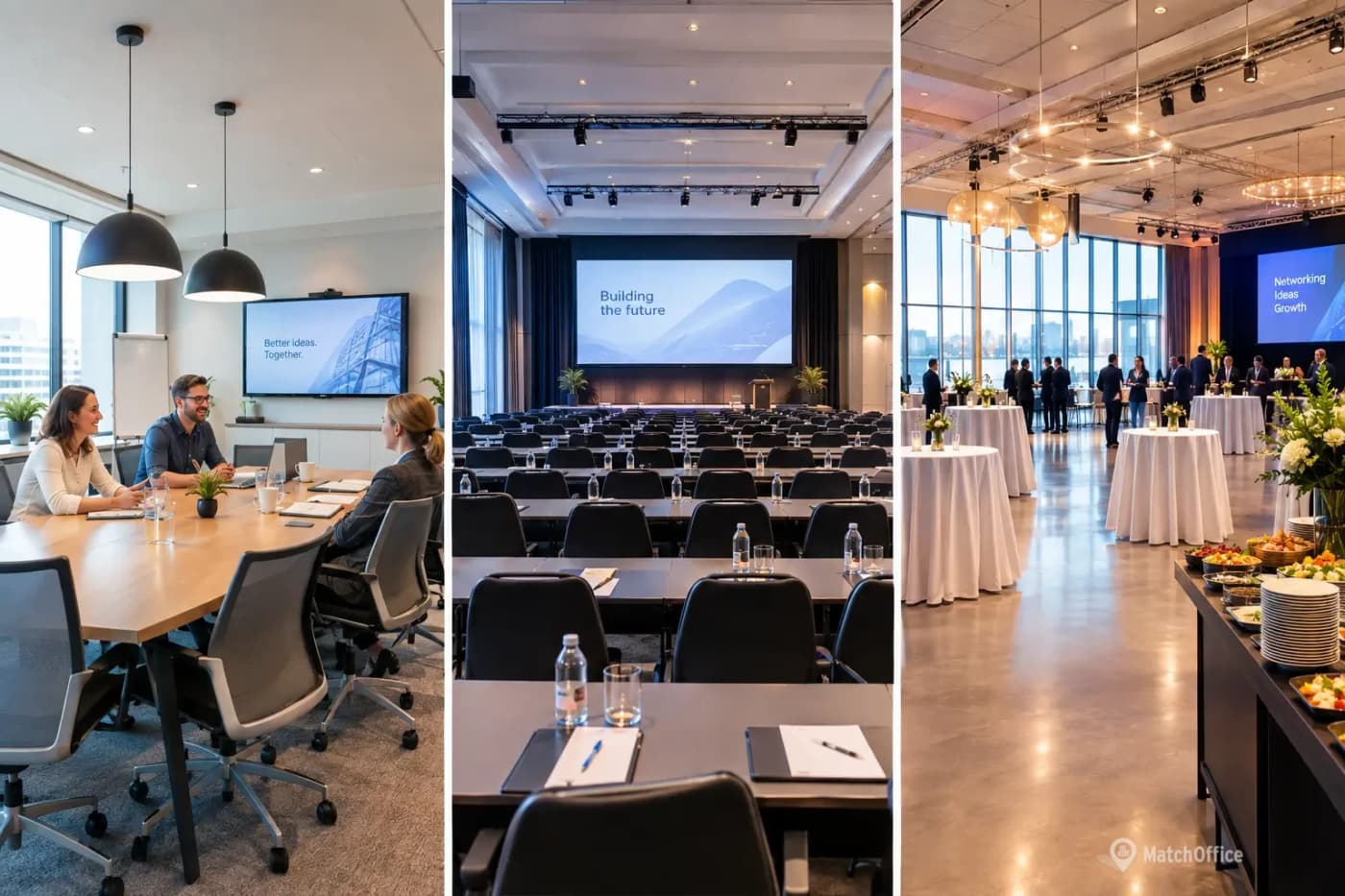
A meeting room is a private room for small to mid-sized groups to discuss, plan or make decisions. A conference room is usually larger and better equipped, and is used for presentations, video calls and structured sessions. An event space is a flexible venue for larger gatherings such as product launches, seminars and receptions. Which one you need depends on what the gathering is for, how many people attend and how much they need to interact.
The three terms are often used interchangeably, and their meaning shifts from country to country, which makes listings harder to compare than they should be. This guide explains what each space is, where they overlap and how to pick the right one for your meeting.
Meeting room, conference room and event space at a glance
| Meeting room | Conference room | Event space | |
|---|---|---|---|
| Main purpose | Discussion, planning, interviews, team sessions | Presentations, video conferences, structured meetings | Launches, seminars, conferences, receptions, networking |
| Group size | Small to mid-sized | Mid-sized to large | Large |
| Typical layout | One table, everyone facing each other | Table-based or rows facing a screen | Flexible: theatre, cabaret, classroom or standing |
| Interaction | High: everyone takes part | Mixed: presenting and discussion | Mostly one-to-many, with networking |
| Equipment | Screen, Wi-Fi, whiteboard | Video conferencing, larger displays, microphones | PA system, stage or presentation area, event lighting |
| Typical booking | By the hour or half-day | Half-day or full day | Full day or evening, often with catering |
What is a meeting room?
A meeting room is an enclosed, private room where a small or mid-sized group can talk, work together and make decisions. It usually has one table with seats for everyone, a screen for sharing content and reliable Wi-Fi. Meeting rooms suit internal team sessions, client meetings, job interviews and planning workshops: meetings where every attendee is expected to take part.
Most company offices have meeting rooms, but you can also book them externally. Business centres, coworking spaces, hotels and dedicated meeting room providers rent rooms by the hour, half-day or full day. That flexibility is why many businesses rent a meeting room for occasional meetings instead of keeping one of their own.
The smallest type is often called a huddle room: a compact space for short, informal meetings or quick video calls, common in modern offices.
What is a conference room?
A conference room is used for structured meetings, presentations and video conferences, usually with a larger group than a standard meeting room holds. The equipment is typically more advanced: larger displays, a video conferencing system, microphones that pick up the whole room and sometimes a presenter area at the front.
Conference rooms are for meetings where information is presented as well as discussed, such as quarterly reviews, client presentations, training sessions and video meetings that connect several offices. You'll find them in corporate offices, hotels, business centres and conference venues.
What is an event space?
An event space is a venue or room for larger gatherings built around a programme rather than a single discussion. Corporate uses include product launches, seminars, conferences, award ceremonies, networking events and company-wide meetings. The same room can be set with rows of chairs for a keynote, round tables for a dinner or an open floor for a reception.
Event spaces usually have infrastructure that meeting and conference rooms lack, such as a PA system, a stage or presentation area, event lighting, room for catering and space for exhibitors or registration desks. When searching, add "corporate" to "event space". The broader term also covers venues for private celebrations such as weddings and parties, which are set up and priced differently from business events. Event spaces can be set up in several meeting room layouts, from theatre-style rows to cabaret tables, which is rarely possible in a standard conference room.
Meeting room vs conference room: the key differences
Four factors separate a meeting room from a conference room:
- Size: conference rooms usually hold larger groups.
- Equipment: conference rooms more often have built-in video conferencing and room-wide audio; meeting rooms tend to rely on a screen and attendees' own devices.
- Format: meeting rooms suit discussion among equals; conference rooms suit sessions where someone presents or leads.
- Formality: conference rooms are often used for client-facing or cross-office meetings; meeting rooms for day-to-day collaboration.
In practice, venues in different markets may give the same room different names. When comparing listings, look at capacity, layout and equipment rather than the room's name.
Conference room vs event space: the key differences
A conference room has a fixed set-up that stays largely the same for every booking, and the group usually stays seated for one session. An event space is rearranged for each event and can host a full programme: arrivals, presentations, breaks, catering and networking. It can also take several layouts, from theatre-style rows to cabaret tables, which a standard conference room rarely allows.
Choose a conference room when the gathering is essentially a large meeting. Choose an event space when it's an event: people move around, there's a stage or keynote, or hospitality is part of the day.
Regional terms you will see in listings
Room names vary between English-speaking markets, and international platforms mix them. These are the terms you're most likely to see:
- Conference hall: widely used in India, South and Southeast Asia, Africa and Türkiye for a large room or auditorium used for conferences and seminars. In the UK and US, the equivalent is usually a large conference room or a conference venue.
- Function room: common in the UK, Ireland and Australia for a room in a hotel, pub or club that can be hired for private or corporate functions.
- Conference venue: a building or complex dedicated to conferences, typically with several rooms of different sizes, catering and on-site event staff.
- Huddle room: a small office meeting room for short meetings and video calls, mainly used in the US.
- Meeting space: a general marketing term that can mean any of the above. Check the listing to see which type of room is actually on offer.
How to choose the right space for your meeting
Start with the purpose of the gathering, then match it to a space:
- Team discussion, interview or client meeting: a meeting room.
- Presentation, training session or meeting with remote participants: a conference room with video conferencing.
- Seminar, product launch, networking event or company-wide gathering: an event space, ideally a corporate one.
Then check three things for any room on your shortlist: capacity in the layout you need, the equipment included and whether catering is available on site. If attendance or format is uncertain, choose the space that fits the largest realistic version of your gathering.
Our step-by-step guide on how to rent a meeting room covers the booking itself: choosing a location and venue type, comparing pricing models and checking booking terms before you confirm.
Find meeting rooms, conference halls and event spaces on FindMeetingRooms
FindMeetingRooms lists meeting rooms, conference halls and event spaces in cities across Europe, North America, Asia, the Middle East, Africa, Australia and South America. Listings are organised by country and city, so you can compare rooms by location, capacity and facilities and contact venues directly.